


Can Two People of Different Heights Share a Riser Recliner?
Can Two People of Different Heights Share a Riser Recliner? Practical guidance on the things to consider, the common compromises and what to check before making a decision.
- What task or journey is difficult at the moment?
- Is the difficulty mainly pain, fatigue, balance, strength, reach, confidence or something else?
- Where will the equipment be used and stored?
- Will somebody else need to lift, push, adjust or maintain it?
- Does the solution still need to work on a more difficult day?
What matters most in practice
Assessments & Professional Advice
Where transfers, posture, pain, fatigue, balance or changing ability are involved, an assessment can help separate the symptom from the practical problem. The aim is not to recommend the most equipment, but the least complicated solution that genuinely helps.
Buying & Comparing Equipment
Comparing specification sheets can narrow a shortlist, but it cannot tell you how equipment feels in real use. Try realistic movements, allow enough time to notice discomfort, and compare the features that affect your own routine rather than paying for features you may never use.
Fit and comfort need a real trial
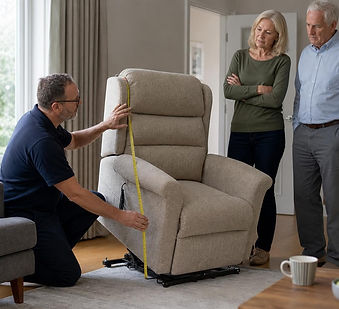
A product can be the correct category and still be the wrong fit. With riser recliner, look at the whole position and movement needed to use it. Check reach, joint position, support, space around the body and whether adjustments can be made without a struggle.
Try it for long enough to notice what happens after the first few minutes. People naturally sit or stand differently when they are concentrating on a demonstration. A little extra time often reveals pressure, awkward reach or a control that initially seemed fine.
Think about the environment
Measure the real space rather than relying on memory. Doorways, furniture, thresholds, slopes, floor surfaces, car boots and turning areas can all change what is practical. If the equipment will be used in more than one place, consider the most demanding environment rather than only the easiest one.
Also think about storage. Equipment that is difficult to put away, charge or retrieve can become a daily frustration. The best solution should be convenient enough to use when it is needed.
Do not overlook the person helping
If a partner, family member or carer will regularly handle the equipment, include them in the trial. Pushing, lifting, folding, adjusting and cleaning are all real tasks. A solution that works beautifully for one person but creates an unreasonable physical job for somebody else may not work well for the household.
Try before you buy
For riser recliners, a proper trial is one of the best ways to avoid an expensive mistake. Do the movements you will repeat at home. If the product travels, try the transport process. If it will be used outdoors, think about realistic surfaces. If it is for sitting or sleeping, give yourself enough time to judge comfort.
- Set the equipment up as it would normally be used.
- Complete the whole activity rather than only one easy part of it.
- Check the controls or adjustments without somebody doing them for you.
- Notice any pain, strain, instability or awkward reaching.
- Consider how the same task would feel when tired.
- Ask what support, servicing or spare parts are available later.
Common mistakes to avoid
- Buying by price alone. Value includes suitability, support and how long the equipment remains useful.
- Choosing from dimensions without trying it. Small differences in shape and position can make a large practical difference.
- Solving one problem and creating another. Think through storage, access, lifting and the effect on other people in the home.
- Assuming bigger means better. Extra size or features are useful only when they help with a genuine need.
- Rushing the decision. Mobility equipment is personal. Take enough time to compare.
When professional advice can help
Some choices are straightforward. Others involve transfers, posture, falls, progressive conditions, complex home layouts or several competing needs. That is where an Occupational Therapy perspective can be particularly useful.
Sara, our Occupational Therapist, looks at the activity as a whole: the person, the task, the environment and what may change in the future. Sometimes that confirms the product somebody had in mind. Sometimes a simpler or completely different solution makes more sense.
Our final advice
When considering can Two People of Different Heights Share a Riser Recliner, start with what you want to do, test the complete activity and choose the least complicated solution that does the job comfortably and safely. Do not be afraid to reject a popular product if it does not suit you.
At Fen Mobility Centre you are welcome to take your time, try different options and ask questions. We would rather help you understand the differences properly than rush you towards a particular riser recliner.